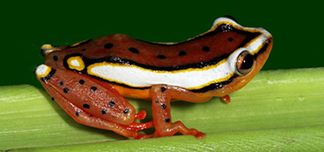
Hyperolius vilhenai is a small anuran that is known from a single location in northeast Angola. Its ecoregion of occurrence is the Angolan Miombo woodlands. The natural colour is a pale green, punctuated with darker ventral blotches.
In 2004 the species was classified as Data Deficient (ver 3.1) by the IUCN due to the paucity of field observations (Schiøtz & Channing, 2004) However, it is likely that the taxon will qualify for some threatened status due to the minimal recording, and due to the general nature of the underlying habitat, since the human population is expanding, and not only are there minimal national protections for wildlife, but the entire region has been ravaged with warfare and neglect since 1974, including the ongoing legacy of prolific land mines (WWF & Hogan, 2007)
H. vilhenai is considered a small Hyperolius occurring in northeastern Angola with a squat body and a sizeable, broad head, exhibiting a rounded snout. Colour in vivo is a pale green; after preservation, the dorsum presents a light background with large dark spots. A dark band extends from snout tip to upper eyelid. This description is based upon the single holotype specimen. According to Laurent's original description, the holotype is a male with developed gonads. If this description is accurate, this anuran does not exhibit a gular flap or gular sac (Laurent, 1964; Schiøtz, 1999).
The snout to vent length of the adult male holotype of H. vilhenai was 21 millimeters (Laurent, 1964).
H. vilhenai is known only from the type locality, from Cuilo, along the Luita River, in Lunda, northern Angola (Schiøtz, 1999). The ecoregion designation is within the Angolan Miombo woodlands (WWF & Hogan, 2007)
H. vilhenai was found in gallery forest in the humid savannah zone, and is considered a terrestrial species (Schiøtz & Channing, 2004). The occurrence of the holotype is within the Angolan Miombo woodlands ecoregion (WWF & Hogan, 2007) It is thought to breed in freshwater.
As of the year 2004 the IUCN asserts there is minimal reliable data on this anuran, since there have been no recent records of observation, presumably due to the lack of herpetological work within its range (Schiøtz & Channing, 2004). As WWF and Hogan (2007) point out, the lack of biological research in this region of Angola from 1974 to present derives from the longstanding instability and warfare commencing when Cuban mercenaries invaded in 1974 to destablise the country (WWF & Hogan,. 2007).